
Phone: (647) 894 7706
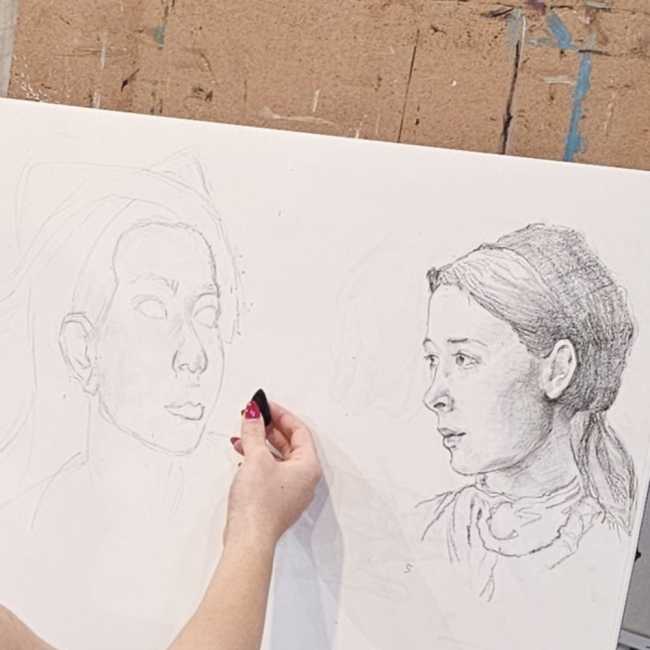
One of the best parts about drawing classes is their evolutionary nature. As your child advances through their various stages, they get to learn about new concepts and acquire new skills, like using hard, soft, and lost edges, for example.
Cross-contour drawing falls into the same category. At VR School of Art, Toronto’s top art school led by renowned artists, we reserve cross-contour drawing for kids aged 8 and above. In today’s blog, we will tell you what it’s about and how it can help your child become a better artist.
Cross contour drawing is a technique that is taught in intermediate-level drawing classes for kids. It is defined by lines that move across the entire surface of an object to help students understand their three-dimensional nature.
Take, for example, a cylinder. Drawing horizontal lines around it helps kids understand how shapes like cylinders curve to look round. Vertical and diagonal lines serve the same purpose and can be used depending on the direction or the structure of the subject in question.
The simple reason why cross-contour drawing is taught in drawing classes is that it helps young artists understand form, volume, and direction of a subject. Drawing these lines reveals the flatness or roundness of a surface. It also sheds light on how a single object can have multiple directions as the lines twist and turn on the canvas.
Cross-contour drawing is extremely helpful in learning how to draw human figures. The human body is made up of interconnected forms that curve, overlap, and change direction. Learning cross-contour drawing ensures kids can replicate it more accurately.
As kids move from beginner to intermediate level classes, they will get to study new techniques and nuances of drawing, sketching, and painting. By acquiring the skill of cross-contour drawing, they will be better equipped to create more complex and dynamic artwork. However, being under the guidance of the right mentor is necessary for that.
VR School of Art’s accomplished and renowned art teachers can help students master all the diverse techniques that help in shaping a good artist. Contact us to learn why our drawing classes are perfect for young and untapped talent.
Yes, they can be. Their purpose is to be guiding lines. They can either be blended in, lightened, or erased once a drawing is complete.
Absolutely. They can be sharp lines too as long as they display the direction and curvature of an object accurately. Tonal shading is not required.
Cups, bottles, shoes, fruits, and other simple or rounded structures are the best ones to begin with. Since their surfaces change direction quite clearly, it becomes easy to follow their shapes with cross contour lines.