
Phone: (647) 894 7706
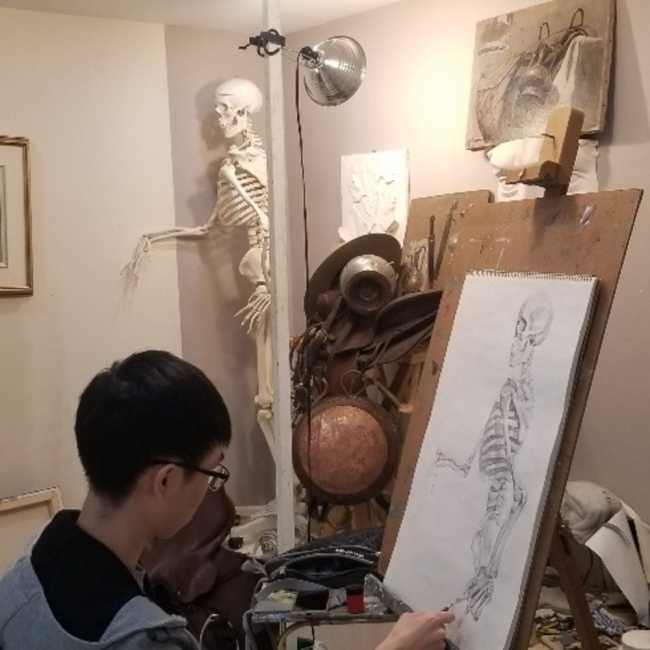
While beginner art lessons focus on teaching students about materials and different composition techniques, advanced courses take it up a notch by introducing plaster casts into the mix. An essential part of classical art education, this style encourages young artists to study three-dimensional forms and translate what they see onto canvas.
Taught at VR School of Art as well, North York’s top art school, learning to draw with plaster models helps students develop precision, understand scale, and tackle very complex subjects. Let’s dive deeper into it in today’s blog.
Advanced art courses in Toronto like ours are designed to help students acquire new skills while refining existing ones. With our plaster drawing sessions, we help students:
Plaster casts allow students to observe the subject in front of them from every angle while understanding how it occupies space. They also get to observe the artistic challenges that architectural elements, sculpted details, and facial features represent. Furthermore, plaster casts also help students identify the form a structure rather than blindly copying its outline.
Plaster models are a great means to analyze how light interacts with real 3D objects. The surface direction of these models creates variations in light and shadow, which students can study to recognize the overall volume of their subject.
Moreover, the contours of physical casts are well-defined, helping students differentiate between its silhouette and internal boundaries. This helps create lifelike artwork.
Representing a 3D object compellingly onto canvas is a major challenge for most students. However, dedicated classes help them learn how to make critical decisions regarding the proportion, perspective, value, and detail placement of their subject.
In fact, a complex ornamental cast is a great way to understand overlapping forms and subtle transitions that might otherwise be hard to detect. Hence, plaster cast painting encourages students to sharpen their observational skills during their art classes in Toronto.
Sustained practice is key to mastering plaster cast drawing. As an expert-led art studio in North York, at VR School of Art, we sequence our plaster cast classes in increasing difficulty to help students gradually improve their grasp of complex 3D forms. Contact us to learn how our drawing classes support the deeper understanding of real-life forms and proportions.
The major difference between the two is that a photo is still a flat subject, whereas a plaster cast is a three-dimensional medium that lets students examine its details, light and shadow interactions, and the space it occupies in relation to its surroundings.
Plaster casts are generally white to prevent distractions from strong colors and help students focus on their form and tonal relationships.
The complexity of the model determines the time it takes to complete any given plaster cast drawing. There is really no fixed time to finish any artwork.